Imagined Communities: Reflections on the Origin and Spread of Nationalism
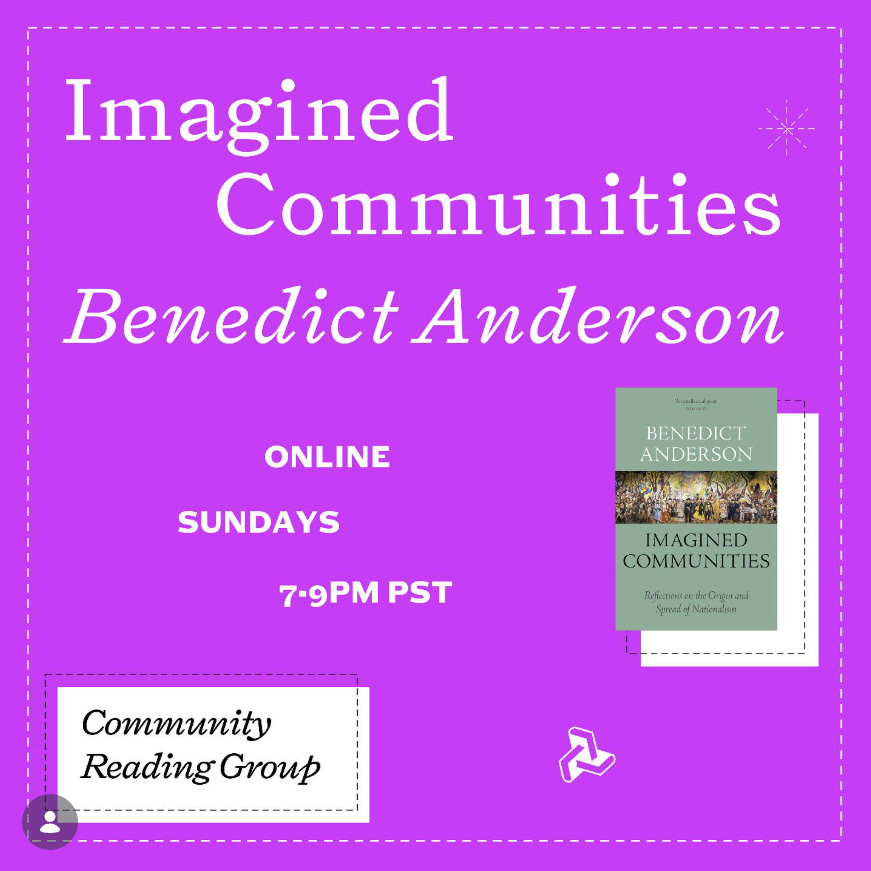
Design by CRG
medium (n.)
1580s, "a middle ground, quality, or degree; that which holds a middle place or position," from Latin medium "the middle, midst, center; interval," noun use of neuter of adjective medius "in the middle, between; from the middle" (from PIE root *medhyo- "middle").
Many of the secondary senses are via the notion of "intervening substance through which a force or quality is conveyed" (1590s) and "intermediate agency, channel of communication" (c. 1600). From the former, via application to air, etc., comes the sense of "one's environment or conditions" (1865). From the latter comes the sense of "a print publication" (1795) which later grew into the meaning in media.
Opening Remarks
The question of belonging or national identity rarely has a straightforward answer. For me, it is especially so. I am a United States citizen of mixed Jewish and ethnic Ukrainian ancestry – identities that have occasionally been a point of confusion even in my own family. I was raised in Saint Petersburg and came to the US as a teenager following the collapse of the Soviet Union. To my American peers, I am simply Russian even though my ancestors hail from Zaporizhzhia and Korosten, which are two cities that belong to modern-day Ukraine but have been subject to a litany of territorial disputes over centuries.
I can trace the rise of nationalism in my own lived experience across all three of my countries of origin. For example, when I was a child, the distinction between Russian and Ukrainian was of relatively little consequence, we were all Soviet. Unlike other Soviet Republics annexed by force, Ukraine and Russia’s union was one of the less objectionable ones. But as the Soviet regime fell, the purchase of national distinctions came back with a vengeance. By the time I reached my twenties, Putin’s anti-Western propaganda machine had rendered me a suspicious American to the few people I left behind in Saint Petersburg that I call friends. Now, not only was I suspect for my Jewishness but this scrutiny was backed up by my so-called Western-ness.
Today my family is scattered between the diasporas of refugees who settled in the United States and Israel. As a Soviet Jew, there is an irony that is not lost on me that I contemplate nationhood at a time when Russia is bombing the people of Zaporizhzhia – technically a mostly Russian-identifying population – under the pretext of answering “Ukrainian aggression.” While at the same time, Palestinians in Gaza are preparing for Israel’s second naked attempt at a revanchist land grab. To positively affirm a sense of national belonging at the crossroads of these histories is at best absurd and at worst perverse.
As nationalist movements reignite across the globe, I wish to explore the origins of nationalism in order to imagine a world no longer in its shadow. I am excited to read one of the most influential studies on the topic, and I invite others to join me as a means to make sense of the present. Together, we might sketch an alternative to a world fractured by a logic of division and exclusion.
— Masha Yamnitski
Supplementary Resources