Mission
Convening every Sunday, the Community Reading Group is a gathering in the spirit of a tertulia where each member is committed to studying the rhetorical construction of community and its associated terms, such as the individual, the family, the people, or the collective.
This site aims to serve as a bridge between the knowledge-production that occurs within the university and the insights gleaned from embedded work in organizing spaces. Our work is to dwell in the complexity that adheres to the demand for praxis and the limits of theory.
If you’re a political and/or spiritual organizer who struggles with a disconnect between the transformations you hope to realize and the language at your disposal, or you simply just love the exercise of close reading an intellectually challenging book, then you will be in good company here.
History
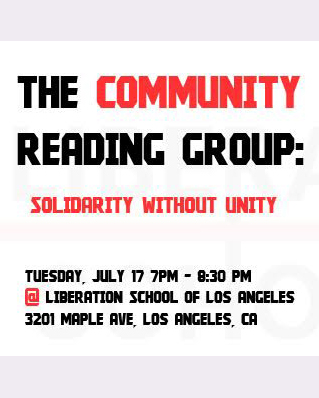
In 2018, the Community Reading Group began as a general interest study group to explore the continental response to the communitarian debates in the Anglophone world throughout the 1980s and 90s. Our first meeting was supported by the Liberation School of Los Angeles and generously hosted by Skira Martinez, Director of CIELO Galleries and Studios in Boyle Heights. (The impetus to form this initial meet-up would have never come to fruition if it were not for the encouragement of artist Hans Kuzmich, to whom a special debt is owed.) In 2019, we moved to our permanent home at the Los Angeles Contemporary Archive in Chinatown.
Over time our numbers ebbed and flowed; nevertheless, a steady stream of new arrivals kept our philosophical pursuits alive. Today, our focus has shifted away from communitarianism and toward philosophies of freedom, histories of emancipatory struggle, and theorizations of the commons (and its appositional under-). We have amassed a consistent and committed group of intellectuals who attend our weekly seminar and, in their respective ways, integrate the question of community in their praxis. In addition, our focus has broadened beyond the mere discussion of scholarship and is now aimed toward discursive production. While many voices have shaped and perfected our commitment to one another, some deserve to be amplified in particular; they are Olivia Leiter, Joy / Jade, Hailey Loman, Michael Berlin, Eve Ruether, and Zach Whitworth.
– Andrew McNeely
Sponsor
Los Angeles Contemporary Archive ⟶
LACA is a public archive and library dedicated to contemporary art-making. LACA collaborates with artists to build archival collections, which include studio leases, contracts, paystubs, performance apparel, set pieces, police reports, text messages, class syllabi, and materials from formally running art spaces. These collections enable us to learn from each other’s experiences and create new works that privilege the desires and needs of our communities. Donate here to contribute.
Follow Us
Headquarters ⟶
Los Angeles Contemporary Archive
709 N. Hill St
Los Angeles
Discord ⟶
Available to members. To inquire about joining, write to the email above.
Governance
CRG is not a non-profit. In contrast, we are working toward becoming a member-owned cooperative — a formal structure in which the project is collectively governed by its participants.
Membership is currently free. To join, write to us at communityreadinggroup@gmail.com. We will formalize the cooperative structure when active participation reaches a sustainable threshold. More details to follow as that process unfolds.
Each reading group is organized by a steward, an individual who has committed him, her, or themselves to building and preserving an independent branch of the project.
Current Stewards
Andrew McNeely
Zach Whitworth
Michael Berlin
Evelena Ruether
Past Stewards
Olivia Leiter, Hailey Loman, Joy Park
Credits
Website design and build ⟶ JJ
How It Works
When does CRG meet?
Our primary group meets every Sunday from 7pm to 9pm, Pacific Time. We also have a rotation of morning groups to accommodate Central and Eastern Time Zones. Instructions for upcoming meetings will be sent out by email on Tuesdays.
Do I have to read the current book to participate?
We’re committed to reciprocal attention and shared study — genuine engagement with the research interests of others is core to our mission. However, “engagement” may take other forms than reading, and we regularly share working notes so anyone can follow along.
How does the book selection process work?
Our course of study is collective, which means that we vote on the books we read. After each book is finished, the organizer nominates someone to propose several books to be subject to a vote. Once the winner is decided, members have one to two weeks to procure a physical copy of the book.